
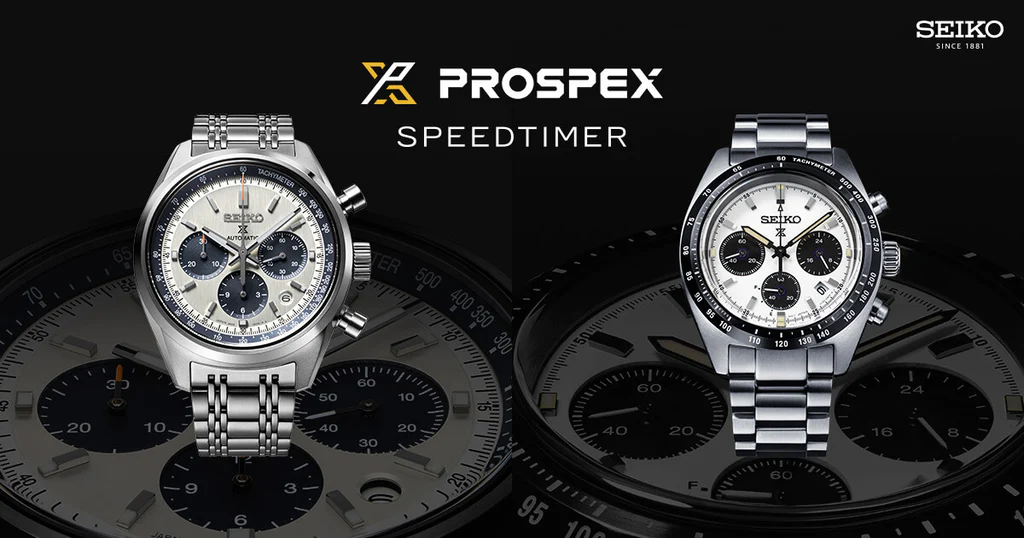
Seiko Chronograph Watches
Few watchmakers have influenced the development of the modern chronograph as profoundly as Seiko. From Japan’s first wristwatch with a stopwatch function to groundbreaking automatic, quartz and solar movements, the history of Seiko chronograph watches is filled with important technological achievements.
Today, Seiko chronographs appeal to many different watch buyers. Some are drawn to the mechanical complexity of an automatic movement. Others prefer the convenience and precision of a solar-powered chronograph. Collectors, meanwhile, may be fascinated by historically significant watches such as the Seiko 6139 Speedtimer.
Let’s explore how Seiko transformed the chronograph and why its modern models remain so popular with watch enthusiasts in Canada and around the world.
What Is a Chronograph Watch?
A chronograph is a watch that includes a stopwatch function in addition to displaying the regular time.
Most chronographs have pushers located beside the crown. One pusher starts and stops the timer, while another resets the chronograph hands. Smaller subdials may display elapsed seconds, minutes or hours.
Depending on the model, a chronograph can be used to time:
- A workout or sporting activity
- A cooking or brewing process
- A commute or road trip
- A presentation or business task
- Laps, intervals or other short events
Some Seiko chronographs also feature a tachymeter scale. When used correctly, the scale can help estimate speed over a known distance.
Although smartphones can perform many of these tasks, a chronograph watch offers a tactile and visually engaging way to measure elapsed time. The detailed dial and added functions also give chronographs their distinctive sporting character.
1964: The Crown Chronograph Begins a New Chapter
A major milestone in Seiko chronograph history arrived in 1964 with the introduction of the Crown Chronograph.
Released during the year of the Tokyo Olympic Games, it was Japan’s first wristwatch equipped with a stopwatch function. Its column-wheel-controlled mechanism was designed to provide reliable and smooth operation.
Unlike many modern chronographs, the Crown Chronograph did not have several subdials. It used a clean, easy-to-read dial and a rotating bezel that helped the wearer track elapsed time.
This combination of precision, legibility and practical design would become a recurring theme throughout Seiko’s chronograph development.
1969: The Seiko 6139 Speedtimer Changes Watchmaking
Five years later, Seiko introduced one of the most important watches in its history: the 1969 Seiko Speedtimer powered by Caliber 6139.
Seiko describes the 6139 as the world’s first automatic chronograph equipped with both a column wheel and a vertical clutch. These components helped improve the smoothness, accuracy and reliability of the chronograph mechanism.
The vertical clutch allowed the chronograph to engage with minimal movement or jumping from the seconds hand. The column wheel coordinated the start, stop and reset operations of the chronograph.
These are still highly respected features in modern mechanical chronographs.
The 6139 also demonstrated that an automatic chronograph could be practical enough for daily wear. Instead of requiring a battery or regular manual winding, the movement generated power through the wearer’s wrist movements.
The Seiko Chronograph That Travelled Into Space
The history of the Seiko 6139 became even more fascinating in 1973.
Astronaut William Pogue carried a Seiko 6139-6005 aboard the Skylab 4 mission. The watch was reportedly used during mission training before accompanying him into space, making the 6139 the first automatic chronograph worn in space.
The yellow-dial version associated with Pogue later became known among collectors as the “Seiko Pogue.”
This space-travel connection helped turn the 6139 from an important technical achievement into a cultural and collecting icon. Original examples are now studied closely for dial condition, bezel configuration, movement originality and reference details.
Seiko Expands Into Digital and Quartz Chronographs
Seiko did not limit its innovation to mechanical movements.
In 1975, the company introduced the 0634, which the Seiko Museum identifies as the world’s first multifunctional digital quartz watch containing a chronograph. This was followed by additional digital watches combining alarms, timing functions and practical everyday features.
Another major advancement arrived in 1983 when Seiko launched the world’s first analog quartz chronograph. The watch combined traditional analog hands with the accuracy and functionality of quartz technology.
Quartz chronographs made accurate stopwatch functions more accessible to everyday consumers. They also required less maintenance than complicated mechanical chronographs and could offer more precise measurement at a comparatively affordable price.
The Development of Kinetic and Spring Drive Chronographs
Seiko continued experimenting with different ways of powering chronograph watches.
The 1999 Kinetic Chronograph combined quartz timekeeping with a system that generated electrical energy through wrist movement. It offered the convenience of quartz while reducing dependence on conventional battery replacement.
Spring Drive later brought together mechanical energy and electronic regulation. A Spring Drive watch is powered by a mainspring, but its unique regulating system provides exceptional accuracy and the smooth gliding seconds hand for which Spring Drive is known.
In a Spring Drive chronograph, elapsed time can be displayed continuously rather than being limited to the nearest mechanical fraction. Seiko also uses vertical-clutch and column-wheel technology to support precise chronograph operation.
These developments demonstrate an important part of Seiko’s identity: the brand is willing to improve traditional watchmaking while also exploring entirely new technologies.
The Modern Seiko Prospex Speedtimer
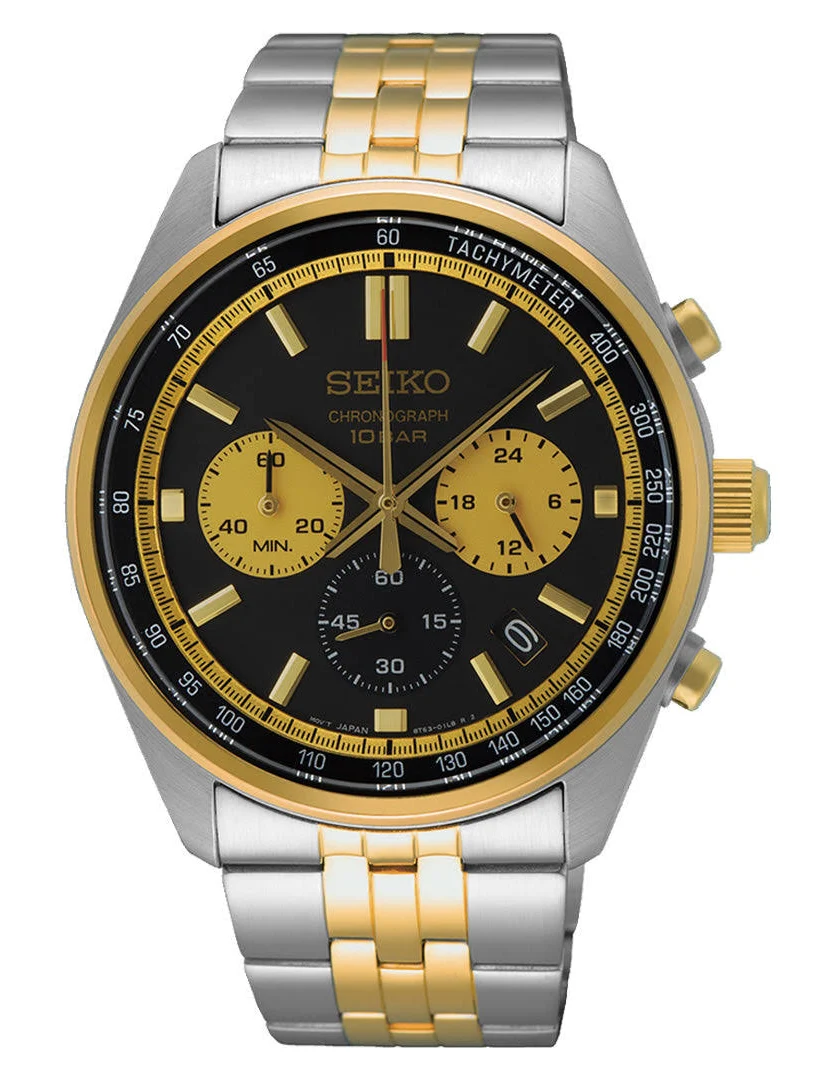
The contemporary Seiko Prospex Speedtimer collection carries the spirit of the 1969 model into a new generation of watches.
Modern Speedtimer models are inspired by Seiko’s history in sports timing and are available with both mechanical and solar-powered movements. The Canadian Speedtimer collection currently includes solar chronographs as well as higher-end mechanical models.
Typical Speedtimer design features may include:
- Highly legible hands and hour markers
- Contrasting chronograph subdials
- Tachymeter bezels
- Stainless-steel cases and bracelets
- Sapphire crystals on selected models
- Water resistance suitable for daily wear
- Sport-inspired dial layouts
- Mechanical or solar movement options
Certain models also use the popular “panda dial” configuration, featuring darker subdials against a lighter main dial. This style has strong associations with vintage motorsport chronographs.
Seiko Solar Chronograph or Automatic Chronograph?
Choosing between a Seiko solar chronograph and a Seiko automatic chronograph depends on how you plan to wear the watch.
Seiko Solar Chronograph
A solar chronograph converts light into electrical energy and stores it in a rechargeable cell.
Its main advantages include:
- High quartz accuracy
- No routine battery replacement
- Convenient everyday operation
- Strong value for the features offered
- A long operating period when fully charged
For example, the Seiko Prospex SSC935 available through B. Serkos uses the V192 solar movement. It offers a chronograph capable of measuring up to 60 minutes in one-fifth-second increments, along with a power-reserve indicator, date display and tachymeter.
A solar Speedtimer is an excellent choice for someone who wants chronograph style and functionality without the maintenance associated with a mechanical movement.
Seiko Automatic Chronograph
An automatic chronograph is powered by a mechanical movement that winds itself through the motion of the wearer’s wrist.
Its advantages include:
- Traditional mechanical craftsmanship
- A more complex and engaging movement
- Strong appeal for watch enthusiasts
- A direct connection to Seiko’s historical chronographs
- No conventional battery
The Seiko Prospex SRQ047, for instance, uses the automatic Caliber 8R48 with manual-winding capability. Its design takes inspiration from a Seiko chronograph released in 1972 and features a panda-style dial with an orange-tipped chronograph hand.
An automatic model may require more care and periodic servicing, but many collectors consider the movement’s construction and operation an important part of the ownership experience.
What to Look for When Buying a Seiko Chronograph
Before selecting a Seiko chronograph, consider more than dial colour or appearance.
Movement type: Decide whether you prefer the convenience of quartz or solar technology, or the craftsmanship of a mechanical movement.
Case diameter: Chronographs can appear larger than simple three-hand watches because of their pushers, bezels and detailed dials. Check both the case diameter and lug-to-lug measurement.
Dial legibility: A chronograph should remain easy to read even with several hands and subdials. Strong contrast is especially useful when timing an activity.
Timing capacity: Some chronographs measure relatively short events, while others can record several hours. Choose a model that matches how you expect to use the function.
Crystal material: Sapphire crystal offers strong resistance to scratching. Hardlex and other mineral-based crystals can provide durability at a more accessible price.
Water resistance: Water resistance varies from one model to another. Check the individual watch specifications instead of assuming that every Prospex or chronograph model has the same rating.
Bracelet and strap: A stainless-steel bracelet can give the watch a more substantial sporting appearance. Leather and fabric straps can make a chronograph feel lighter or more vintage-inspired.
Why Buy a Seiko Chronograph From an Authorized Retailer?
Buying from an established retailer provides reassurance regarding authenticity, warranty coverage and after-sales assistance.
- Serkos is listed by Seiko as a Seiko Luxe Retailer and Seiko Watch Salon in Laval, Quebec. The official listing includes Seiko, Prospex, Presage and Astron among the collections carried by the store.
Shopping with an authorized retailer also gives you an opportunity to:
- Compare several case sizes on your wrist
- Examine dial colours under natural lighting
- Discuss movement and maintenance differences
- Confirm warranty information
- Arrange bracelet sizing
- Receive knowledgeable guidance before buying
Inventory can change, so customers looking for a particular reference should contact the store before visiting.
Are Seiko Chronograph Watches Worth Buying?
For many watch enthusiasts, the answer is yes.
Seiko chronographs combine meaningful watchmaking history with a wide range of technologies, designs and price points. A buyer can choose a practical solar chronograph for regular use, a mechanical Speedtimer for its engineering or a historically inspired model that connects to the brand’s past.
The best choice is not necessarily the most complicated or expensive model. It is the watch that fits comfortably, matches your style and provides the functions you will genuinely use.
Explore Seiko Chronograph Watches in Laval
From the Crown Chronograph of 1964 and the revolutionary 6139 Speedtimer of 1969 to today’s solar and mechanical Prospex models, the journey of Seiko chronograph watches reflects more than six decades of experimentation and advancement.
Seiko has repeatedly found new ways to measure elapsed time while maintaining the legibility, durability and practicality expected from a sports watch.
Visit B. Serkos in Laval to explore available Seiko watches, compare different chronograph movements and find a timepiece that fits your wrist and lifestyle.
|
Explore the Seiko watch collection at B. Serkos |
Frequently Asked Questions About Seiko Chronographs
What is a Seiko chronograph watch?
A Seiko chronograph is a watch that displays the regular time while also offering a stopwatch function. It typically uses pushers and separate hands or subdials to measure elapsed seconds, minutes or hours.
What was the first Seiko chronograph?
The 1964 Crown Chronograph was Japan’s first wristwatch equipped with a stopwatch function. It marked the beginning of Seiko’s modern wristwatch chronograph history.
Why is the Seiko 6139 important?
Introduced in 1969, the Seiko 6139 was the world’s first automatic chronograph equipped with both a vertical clutch and a column wheel. It became even more famous after astronaut William Pogue wore a 6139 during the Skylab 4 mission.
Are Seiko solar chronographs reliable?
Seiko solar chronographs are generally valued for their quartz accuracy, convenient light-powered charging and low routine maintenance. Specifications vary, so buyers should review the exact caliber and model information.
Does a Seiko solar chronograph need a battery?
It uses a rechargeable power cell rather than a conventional disposable watch battery. Light charges the cell, allowing the watch to operate for an extended period when fully charged.
Is an automatic chronograph better than a solar chronograph?
Neither is universally better. An automatic chronograph offers traditional mechanical craftsmanship, while a solar chronograph usually offers greater accuracy and convenience. The right option depends on the buyer’s preferences.
Where can I buy a Seiko chronograph in Laval?
- Serkos is a Seiko Luxe Retailer and Seiko Watch Salon located in Laval, Quebec. Customers can visit the store to explore available Seiko and Prospex watches and receive assistance selecting the right model.
Related Posts
Latest Posts
Do Seiko Watches Hold Value in 2026? What Collectors Should Know Before Buying
Do Seiko watches hold value? The honest answer is: some [...]
Watch Repair in Laval: Battery, Sizing & Waterproof Testing
If you searched for “watch repair in Laval,” you are [...]
Jewelry Trends 2026: Top Styles You’ll See Everywhere | B. Serkos
Jewelry trends 2026 are all about expression, meaning, and versatility. [...]
Men’s Jewelry Style Guide: 5 Confident Ways to Wear Jewelry
Men’s jewelry style has evolved far beyond watches and wedding [...]

Holiday Hours + Gift Guide: Jewelry, Watches & In‑House Repairs in Laval (Dec 2025)
If you’re shopping for the holidays (or getting your favorite [...]
Is Oris a Respected Watch Brand? A 2025 Buyer’s Guide to Swiss Independence & Value
Short answer: Yes. Oris is widely respected for delivering Swiss‑made [...]

